
The 2025 Budget – A Game of Two Halves
Yesterday’s Budget was one which gave with one hand and took away with the other, as the government sought to address three priorities at the same time – demonstrate resolve to tackle cost-of-living issues, shore up public finances and quieten restive Labour back-benchers. The clear narrative emerging from the Opposition is that Labour has put up taxes to pay for welfare – that is not the message the Government would have wanted to send.
The Figures
Taxes have gone up by £66 billion in two years, raising the country’s overall tax burden to 38.3% of GDP - the highest in peacetime.
The OBR’s growth predictions have increased for this year, but declined for every subsequent year of this Parliament. And even this year’s 1.5% GDP growth is scarcely a roaring rate.
The OBR noted that until the UK’s long-standing productivity issue is solved, there is no real growth on the horizon.
There is some good news…
Inflation is on its way down (but is still more than 50% above the Bank of England’s target rate).
Whilst government borrowing has also hit new heights – the OBR expects it to climb to above £138 billion in 2025-26 – the OBR projects steep declines thereafter (reaching £67.2 billion in 2030-31).
OBR projections show that the UK will cut its national debt more aggressively than any other G7 country (except Germany) and that by 2029, the UK will be running a fiscal surplus.
Perhaps most importantly, for this particular budget, the Chancellor has given herself more headroom – doubling the fiscal current shock-absorber to nearly £22 billion.
In response to the Budget, Sterling rose, gilts rallied and the 10-year yield fell, signalling markets’ relief at ‘no nasty surprises’
So what conclusions should we draw?
If to govern is to choose, then this Budget was all about choices – mostly political and tactical and taken with a steady eye on the opinion polls and, importantly, Labour’s backbenchers - hence, a large part of the Budget being dedicated to give-aways, to placate the PLP and the Labour faithful.
Given that all the talk in the run-up to this Budget was about how fragile support for the occupants of Numbers 10 & 11, it is fair to ask the question – did it do enough to shore up their support?
I think the answer has two parts. Short-term and Long-term. In the short-term, I think the Budget has sealed some of the gaping holes that were making the Good Ship Labour so unsteady over the last few weeks: there will be no revolution next week…Long-term, I have grave doubts that this Budget will reverse Labour’s polling decline and therefore save its leaders.
But to take those horizons in turn:
Short-term first. The Treasury is particularly pleased with this chart, showing the distributional impact of Yesterday’s measures:
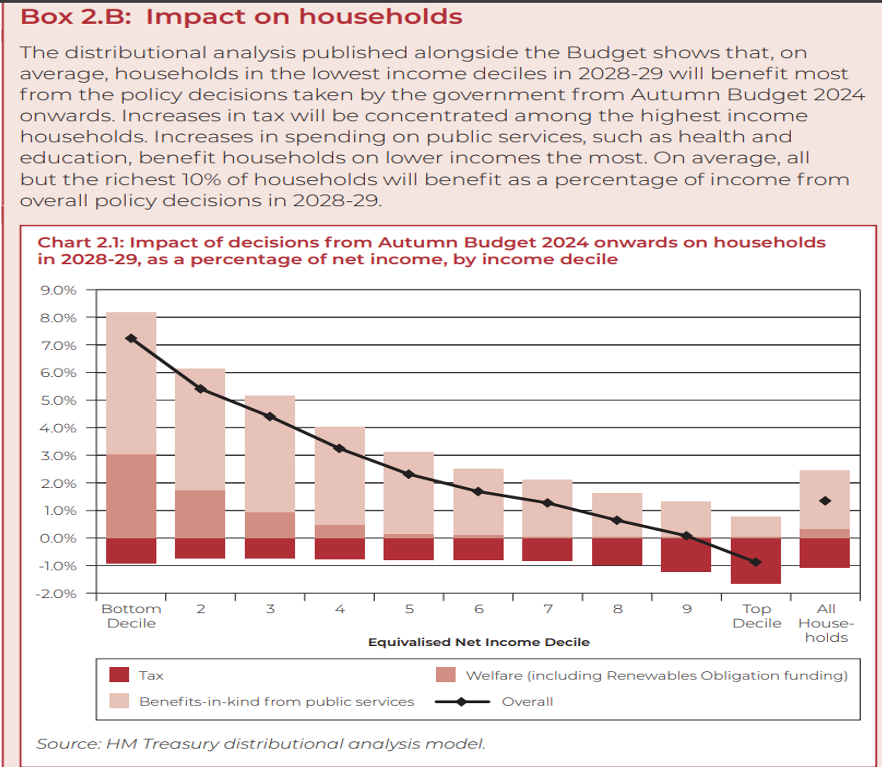
Reeves had promised that ‘everyone would be asked to make a contribution. Those with the broadest shoulders should make the greatest contribution’. HMT’s own figures show that the impact of the Budget fell heaviest on the UK’s top earners, with the weight shifted off the shoulders of the poorest with boosts to welfare spending and minimum wage being portrayed as concrete measures to tackle the cost-of-living crisis. Reeves also injected more money into the NHS.
The ‘giveaways’ are catnip to Labour Party members and backbenchers (they are also the price Reeves has had to pay to ensure their loyalty). The PLP feel this is a much ‘redder’ budget than they had expected, with a range of redistributive measures which are true to Labour’s core values:
The much-hated two-child welfare cap has gone - to huge cheers from Labour and cries from the Tories that working people are paying higher taxes to fund extra benefits. Reducing child poverty is a core Labour value and there is significant research evidence that demonstrates removing the cap is the quickest way to lift children out of poverty.
Benefits will be increased in line with inflation and the national living wage will rise by (an inflation-busting) 4% to £12.71. These measures are close to the core Labour values the PLP hold dear (as their welfare rebellion showed earlier this year)
The cuts to energy bills were also warmly welcomed as a way to rapidly put money back in voters’ pockets so that they begin to feel better off.
Likewise, Reeves chose not to lift the freeze on fuel duty, which helps tackle the cost-of-living crisis (which polls suggest is one of the key ingredients in Reform’s surge).
Higher taxes on landlords and dividends, along with a new “mansion tax” on homes worth more than £2m. Labour MPs welcomed this measure as demonstrating that the wealthy are being called upon to play their part.
But (and to paraphrase Nick Robinson) there is always a but, the long-term still looks bleak…
If the giveaways placated the PLP, then the Budget was a short-term success. It gained time for Reeves and Starmer. But the question the is: time to do what? Which takes me to the weaknesses of this Budget.
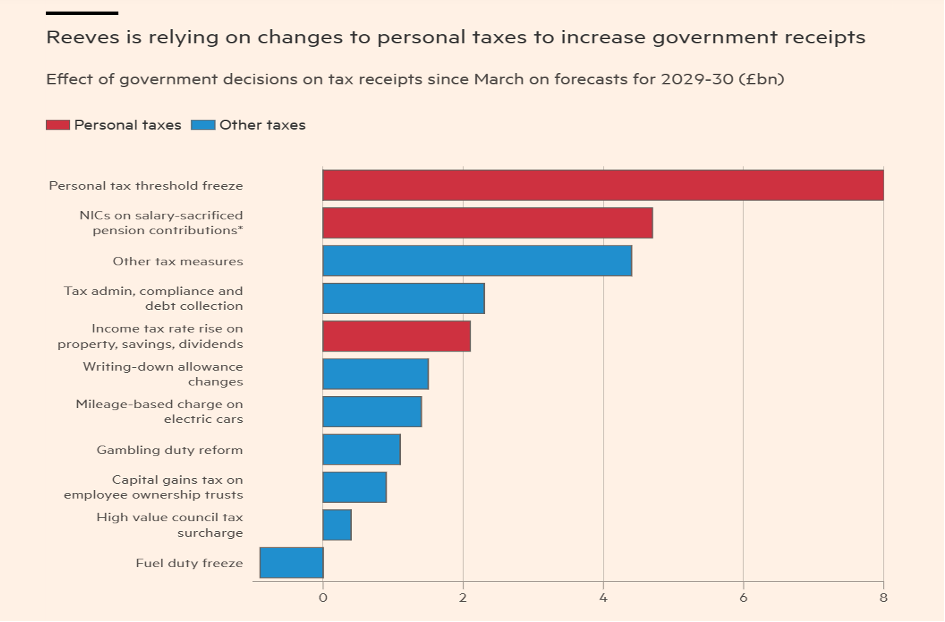
The government’s critics are already pushing out the narrative that this was a something and nothing Budget. And that remains one of the two key weaknesses. This Budget did nothing to address the complaints that the Government does not have a coherent narrative that this Budget pulled together. If Reeves had gone ahead with the Manifesto-breaking rise of income tax, at least she could have had a story to tell of proactivity, of daring to take difficult measures, of coherence. Instead, the Budget has been described as a smorgasbord of changes which tinker around the edges without ever tackling genuine reform. The FT chart below illustrates this very clearly:
The second weakness was the absence from the Budget of a clear-sighted strategy for embedding sustainable economic growth into the UK. Since we are constantly being told by Labour that their number one priority is growth, the failure to leverage this Budget to generate growth is somewhat surprising. In its absence, initiatives which will be broadly welcomed on the left (the mansion tax, for example) risk being portrayed as ad hoc revenue-grabs rather than a strategic effort to convert the tax system into a genuine source of economic growth. The freeze on tax thresholds will increase the number of people paying basic and higher rate taxes, which is not only likely to further slow-down growth and in the longer-term will not help voters feel they are better off.
And this is where Reeves and Starmer are in something of a Catch-22. To survive, they need to control the country’s debt, generate growth and make people feel better off now and have a more optimistic view of the future. These objectives run up against different time-lines. People need to feel better off now – Reform is benefitting from the country’s malaise over the continuing cost-of-living crisis. But real, sustainable growth takes time. And the dynamic of Labour’s current internal party politics is forcing Reeves and Starmer to keep the PLP happy by spending now, before the growth materialises, requiring extra taxes or increased public debt: neither of which make people feel happier about their current circumstances.
This, rather unwelcome observation, leads to the conclusion that, although the Budget may have bought Starmer and Reeves time, the danger to the couple has not gone away.
This Budget was shambolic in its preparation and the number of leaks beforehand. Its delay until late in November served only to heighten uncertainty about its likely content. And the chaos continued right up to the moment of delivery, with the OBR publishing their response to the Budget online about 45 minutes before the Chancellor actually began speaking. Even though that was clearly not Reeves’ fault (and she waws rightly furious about it) the mistake contributed to the building narrative that, not only are they unlucky, but they do not have a grip and events seem to cartwheel away from them far too regularly.
This Budget has not solved any problems. It has merely delayed the moment of reckoning. Many of Reeves’ tax rises will take effect towards the end of this Parliament. Although the economy may be booming by then, obviating the need for rises, it is equally possible that Reeves will find herself raising taxes at just the moment that the Party goes to the country, asking for more time in office. This unfortunate coincidence of timing leads to the next observation – market reaction. Market reaction was overall positive yesterday, but there is a risk that, because so many of the revenue-raising measures are delayed to the end of the Parliament (and nearer, therefore, to the next election), financial markets could begin to question the credibility of the plans and he political determination to see the tax rises through.
And finally, this Budget was intensely tactical. Instead of the daring plan (for which Labour had carefully rolled the pitch) for big tax changes, Reeves has balanced the books, by moving the pieces around the board without upsetting the markets. But the Budget has not materially changed the bigger picture – growth is still anaemic, Labour is languishing in the polls, productivity is down, inflation remains above target. And that, for me, is the biggest difficulty that Reeves and Starmer have: the Budget has done nothing to answer the criticism that Labour does not appear to have a plan for Government – what George Bush would have called ‘the vision thing’. It is all very well shoring up party support for the occupants of Number 10 & 11 Downing Street, but they will only feel they have swum safely to shore when opinion polls start to consistently demonstrate that the UK believes Starmer and Reeves have a coherent strategy, a reason why the financial pain of higher taxes is worthwhile. After this Budget, that moment of safety feels, frankly, just as far away as ever.