It Really is All About China
We woke over last weekend to the news that the USA had effectively invaded Venezuela and rendered its President to the US to face drugs and terrorism charges. Aside from the shock at seeing the country which likes to describe itself as The Leader of the Free World and the Greatest Democracy flagrantly infringing international law it is impossible to escape a sense of rising concern at the precedent that this unilateral and illegal action sets for other despotic regimes around the world.
Of course, really none of this should have come as a surprise. The almighty build-up of US naval forces off Venezuela’s coast was the clearest indication that something was afoot – as we learnt from Russia’s massive military build-up on the frontier with Ukraine on the eve of the invasion, countries rarely move huge amounts of military hardware to another country’s border, merely to withdraw it again.
And, to be fair to the Trump Administration, they had told us clearly that they were going to approach world affairs in a radically different manner. To understand how the worldview of Trump’s Administration would lead, almost inexorably, to the military operation in Venezuela, without having to wade through the 900-page Heritage Project 2025, it is sufficient to read the 33-page National Security Strategy, which specifically warned the reading world that the US would undertake ‘Targeted deployments to secure the border and defeat cartels, including where necessary the use of lethal force’ even where ‘Some foreign influence will be hard to reverse, given the political alignments between certain Latin American governments and certain foreign actors.’
The NSS…
…is an unashamed encapsulation of America First - erstwhile allies can get on board with a new era of US-dominance, or get squashed. The eight decades of trans-Atlantic partnership sacrificed at the altar of the Trump Corollary to the Monroe Doctrine (or, as he has called it in his characteristically modest manner, the Donroe Doctrine) whose strategic intent is unashamedly ‘to restore American pre-eminence in the Western Hemisphere’. The NSS makes no bones about the ultimate goal- to ‘deny non-Hemispheric competitors the ability to position… threatening capabilities, or to own or control strategically vital assets, in our Hemisphere’ by creating an exclusive zone of US influence in which ‘the United States must be preeminent…[and] assert ourselves confidently where and when we need to in the region….Our alliances…. must be contingent on winding down adversarial outside influence—from control of military installations, ports, and key infrastructure to the purchase of strategic assets broadly defined’.
So how does Venezuela fit into this world-view?
Venezuela is in the US Hemisphere of Dominance. Foreign presence is therefore not to be tolerated. Especially if that presence strengthens US enemies. And Venezuela ticks all these boxes: resource rich and heavily-influenced by the enemies of the US who benefit from access to its raw materials in the US’ own back-yard.
Venezuela has the largest oil reserves in the world (The Orinoco Belt contains over 300bn barrels, a fifth of global stock). China has been the number one customer for that oil, lending Venezuela between $60–106 billion from 2007 to 2023 for the financing of infrastructure, energy projects, and social programs and receiving for oil shipments in return (up to 1 million barrels per day at peak). Venezuela started paying for oil in Yuan, thus supporting Beijing’s attempts to undermine the Dollar as the international reserve currency on international markets. Russia is also active in Venezuela’s energy sector, with Rosneft forming a series of JVs with PDVSA across the Orinoco Belt to develop heavy crude reserves. Moscow provided cash through prepayment deals and debt-for-oil swaps, effectively becoming a “credit lifeline” to Venezuela and in return securing a footing in the Western Hemisphere’s largest oil reserves. Iran is in on the game as well, shipping refined products to Venezuela in exchange for heavy crude or gold. The seizure of the Russian-flagged oil tankers yesterday should not be read as a hardening of the US position on Russia, but more as a seizure of oil originating in the US zone of dominance.
Beyond oil, Venezuela also has significant reserves of critical raw materials – as this Guardian article and my sub-stack blog note.
To make matters worse, Venezuela also enjoys close political ties with US enemies. China signed a 2023 declaration framing its relationship with Venezuela as an ‘all-weather strategic partnership’, with ‘strong bonds of brotherhood’. Russia and Venezuela have a ‘comprehensive strategic partnership’ and The Kremlin describes Venezuela as part of its ‘sphere of influence balance’ and views the relationship with Caracas as “hybrid power projection” to counter US dominance in the Western Hemisphere. Venezuela has also cultivated strong diplomatic links with Iran, projecting themselves as the resistance to the US in Latin America in the same way that Iran projected itself as the resistance to Israel in the Middle East. China, Russia and Iran have assisted Venezuela’s military, providing significant quantities of both training and equipment – including for internal suppression and dual-use cyber equipment.
And so, to China…
In the end, everything this Trump administration does on the international scene is motivated by the fear that China will overtake the US to become the preeminent global economic and military power. The NSS addresses this growing concern openly, describing the Chinese and American economies as ‘near-peers’, bemoaning the fact that ‘China got rich and powerful, and used its wealth and power to its considerable advantage’ and describing the Indo-Pacific as ‘the next century’s key economic and geopolitical battleground’.
The identification of access to critical minerals as a key national security requirement is written through the NSS in language that acknowledges deep US concerns at how the Chinese have cornered the mining and processing of the world’s minerals, so essential for the modern economy. The NSS states that it will actively combat ‘threats against our supply chains that risk U.S. access to critical resources, including minerals and rare earth elements’ and notes that, since the Western Hemisphere is ‘home to many strategic resources’ the administration ‘will immediately begin a robust interagency process to … identify strategic points and resources in the Western Hemisphere with a view to their protection and …development’ (an observation which is immediately relevant to Greenland – see below).
The NSS acknowledges China’s huge head-start in accessing these resources in Africa - one of the world’s richest sources of critical minerals - stating that ‘America should …cement and improve … positions…with regard to critical minerals, in Africa’, binding ‘their economies more closely to the Dollar’ in the process. In a desperate appeal to countries in the Global South (to which the NSS refers as ‘the greatest economic battlegrounds of the coming decades’), the language seeks to undermine Chinese development assistance, deriding it as being full of ‘hidden costs’ and ‘debt-traps’; ‘low cost’ and with ‘strings’ [attached]. In what is no doubt intended to be an appeal to countries in the Global South to choose the sunlit uplands of American domination, the NSS offers a rather bleak binary choice ‘[of living].,.. in an American-led world of sovereign countries and free economies or in a parallel one… influenced by countries on the other side of the world.’
And China also lies behind the section of the NSS on Europe that I found hardest to read. If you can get beyond the hypocrisy of the Trump Administration castigating Europe for clamping down on freedom of speech, whilst the White House bans journalists, the DoD allows access to only those media outlets that have agreed not to write anything critical and the DoHS demands 5 years of social media history to check whether a putative entrant has ever had the temerity to criticise the US. And if you can hold your nose to wade through the racist recital of the ‘Great Replacement Theory’, the real message of this section becomes clear: the US is prepared to sacrifice its relations with Europe on the altar of better relations with Russia, relations which the US needs to achieve ‘strategic stability with Russia.’
The NSS believes that the ‘stability’ which can be reached through a peace agreement with Ukraine (the quality of which, from the perspective of the Trump Administration, is immaterial) would offer Russia a much-improved trading relationship with the US - an offer which (from the perspective of Trump’s MAGA followers) will always be preferable and superior to the offering the Chinese are capable of making. The real goal is not to make Russia a friend (State still characterises Russia as an enemy), so much as to prise Russia from China’s grasp, a strategic clasp which MAGA have watched with growing alarm since Russia and China declared their strategic partnership to have ‘no limits’ in February 2022.
And the US competition with China is not limited to critical and rare earth minerals and metals. An entire paragraph of the NSS is dedicated to US ‘restoring American energy dominance (in oil, gas, coal, and nuclear) and reshoring the necessary key energy components. (By) expanding net energy exports (the US) will…curtail the influence of adversaries… and enable us to project power.’ It is notable too the NSS does not miss the opportunity to re-state the Trump administration’s deep hostility towards renewables – ‘We reject the disastrous “climate change” and “Net Zero” ideologies that … subsidize our adversaries.’
China has stolen such a march over the US (and the rest of the West) in renewable energy and access to the raw and processed critical minerals which are essential not only for the energy transition, but also for weapons systems and artificial intelligence that it has left the US floundering in its wake. Given which, it is entirely consistent for Trump to double-down on fossil fuels (where the US still enjoys a comparative advantage) and for his administration to seek out those jurisdictions (especially in the US ‘hemisphere of dominance’) where critical raw materials are still potentially accessible to the US. If Trump can seize those reserves, he can push those rare earths that would otherwise have gone to China for renewables, towards building up US military and technology instead, whilst at the same time, slowing down the energy transition, giving the US time to catch up and diminish China’s advantage and also reducing its leverage over the US – leverage that it has not hesitated to use in the past and which, when it was used, caused economic damage to the US.
All of which brings us to Greenland…
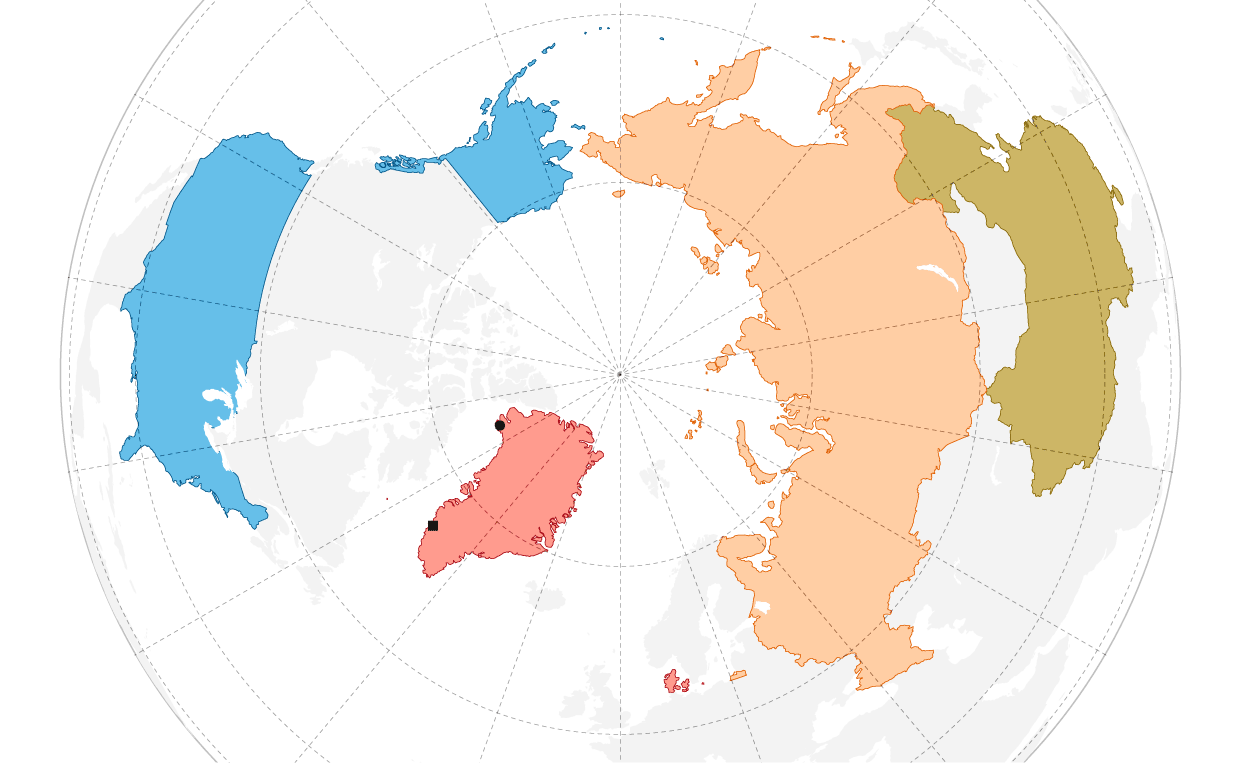
Given the above, we should not be surprised at Trump’s renewed focus on gaining control of Greenland, given its geostrategic location (shown clearly in the Guardian graphic at Annex 1 below).
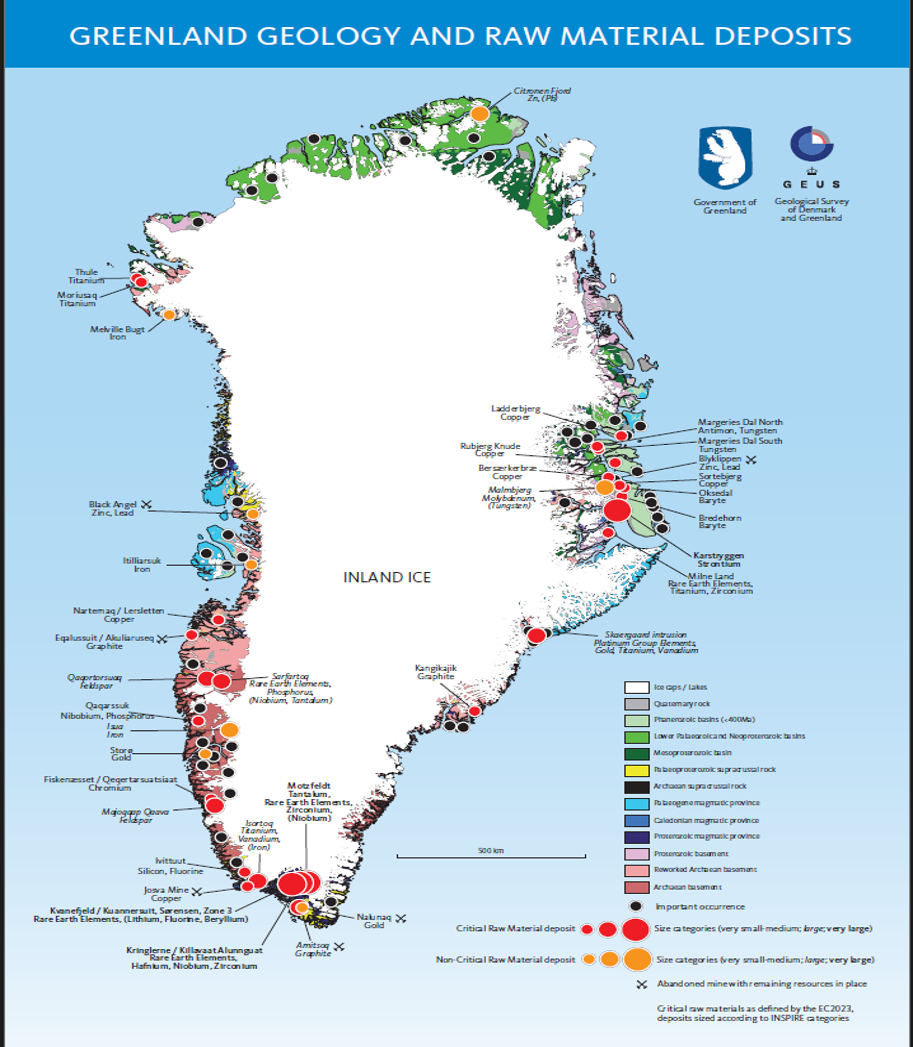
Greenland not only lies in the Western Hemisphere (and therefore, according to the NSS, ‘belongs’ to the US sphere of dominance), it is also a source of significant quantities of critical minerals (as the graphic in Annex 2 below shows) and, perhaps most importantly, as the ice melts, it controls access to the NW and NE passages through which Chinese ships are already venturing. Controlling Greenland, therefore is consistent with the goals of the NSS: increase US dominance in its sphere of influence; secure access to critical raw materials; and stop the creeping expansion of Chinese influence and economic power.
If, as seems likely, Greenland is drifting toward inevitable independence from Denmark in the next decade or so, then it is much better (according to the America First worldview) for control over this huge island, its resources and its sea-lanes access to reside in US hands, rather than risk it falling under the control of the US’ fiercest competitors, Russia or (even worse) China. The motivating factors behind Trump’s assertion that the US ‘needs’ Greenland for its national security are as much that the US under Trump covets its raw materials and geo-strategic location, as that it is prepared to go to almost any lengths to prevent those assets falling into Chinese hands.
Conclusion
The NSS is a staggering document. Impressive in its single-minded determination to put America First in everything. And remarkable for its focus on countering China in what its authors clearly view as a head-to-head, no holds-barred battle for global supremacy. In achieving that outcome, the NSS is prepared to sacrifice every concept of the post-WWII world order. The Western Hemisphere belongs to the US – as this social media post makes clear - and allies are expected to submit to American domination. But the NSS also makes it clear that the US is prepared to act (belligerently if necessary) beyond its zone of influence where it feels its interests are impacted – for example, the NSS makes it clear that the US is not prepared to leave Taiwan as uncontested space, instead continuing to offer security guarantees (not out of any respect for the rule of law, but rather because the US economy depends on chips from Taiwan and the volume of global shipping which passes through the S China Seas).
In reading the document, I could not help noticing that, in addressing countries in the Global South, the US decries the interference of countries on ‘the other side of the world’ without any apparent trace either of irony or recognition that to most Global South countries, the US is also ‘on the other side of the world’. Nor was it possible to ignore the fact that the NSS clearly views the world as split into zones of influence: if you are not with the US (willingly or not); you are against the US - there is no space in that world vision for an independent, or non-aligned country. The NSS is blind to the interests or strategic interests of any other country and inflexible in its dogmatic focus on remaining ahead of the pursuing pack.
And this is the major weakness of the NSS: its naivete. To truly defeat China and maintain its position as the world’s pre-eminent economic, political and military power, the US needs a global network of allies and like-minded nations. But in its obsessive focus on beating China, projecting overwhelming force to dominate and subjugate and carving the world up into power blocs in the pursuit of that objective, the US is blindly alienating those allies, undermining the system that has helped it maintain its leading position for the past 80 years and destroying the trust and friendship which it will need to continue in that role for the decades to come.
In the medium to long-term, the irony of the NSS is that the ruthless America-First methodology that has been chosen as the means to stay ahead of China will be the strategic error that prevents the US from achieving that outcome.
Annex 1
Annex 2